Tricky Hard Words to Spell: Tips, Examples, and Common Mistakes
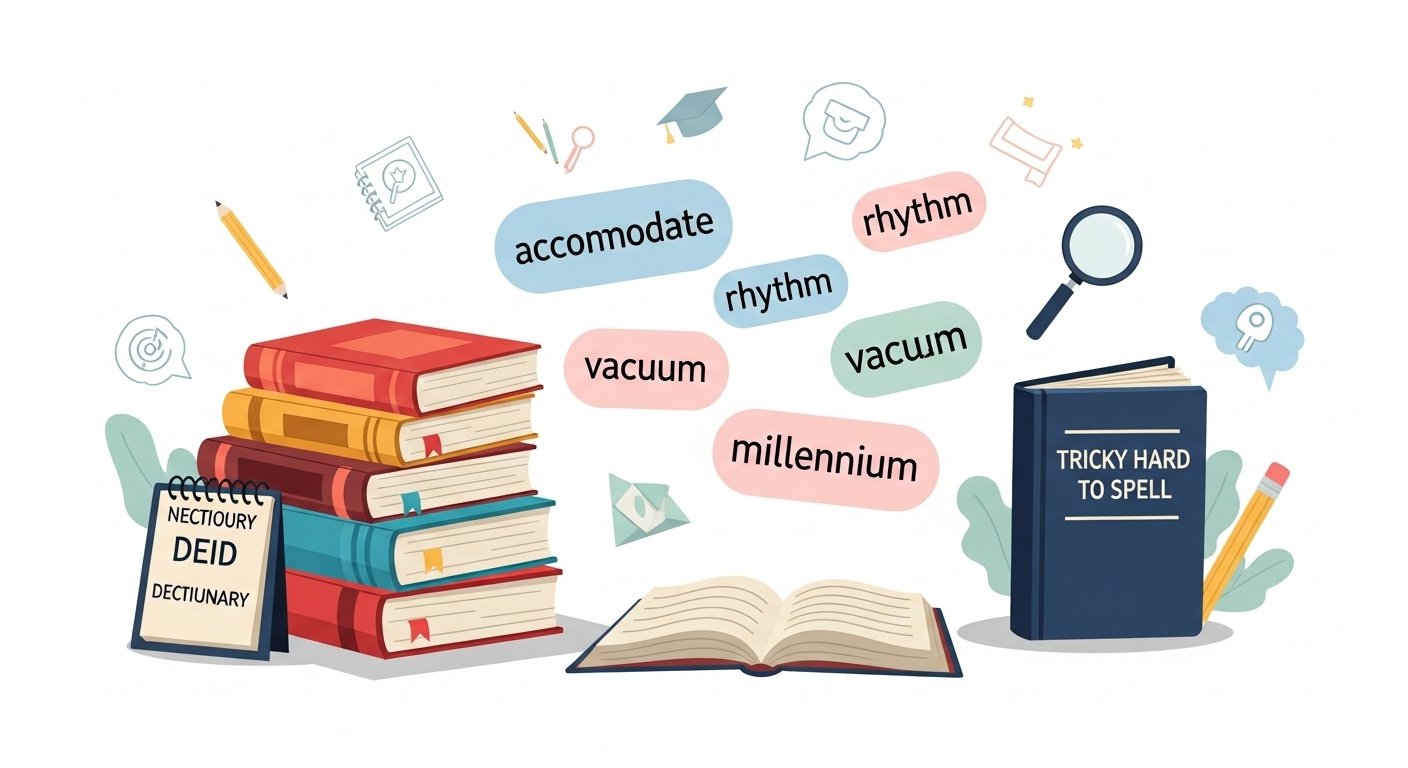
Some words in English are notoriously difficult to spell due to silent letters, unusual vowel combinations, or irregular patterns. Mastering tricky hard words to spell requires understanding patterns, practicing consistently, and using memory techniques.
The Origin of Difficult Spellings
Origin of Complex English Words
Many difficult-to-spell words come from Latin, Greek, French, or Germanic roots. These origins often determine why the spelling seems counterintuitive. For example, “colonel” comes from the French colonnel, explaining its unexpected pronunciation.
How Spelling Rules Have Evolved
English spelling has changed over centuries, influenced by printing, regional variations, and etymology. Irregular patterns persist, which is why even native speakers struggle with words like “rhythm” or “pneumonia.”
Why Some Words Are Tricky
Words become tricky when they contain silent letters (e.g., ballet), doubled consonants (e.g., accommodate), or irregular phonetics (e.g., mnemonic). Recognizing these patterns is key to mastering spelling.
British English vs American English Spelling
British English Usage
British spellings often preserve traditional or etymological patterns, like favourite or moustache.
American English Usage
American spellings simplify some patterns: favorite, mustache. Understanding these differences helps writers adjust for their audience.
Comparison Table
| Word | British Spelling | American Spelling |
|---|---|---|
| Colour | Colour | Color |
| Centre | Centre | Center |
| Defence | Defence | Defense |
| Theatre | Theatre | Theater |
Which Spelling Should You Use?
For US Audiences
Use American spelling to match expectations: defense, center, favorite.
For UK and Commonwealth Audiences
Stick to British spelling for authenticity: defence, centre, favourite.
For Global Communication
Consider the audience’s familiarity; neutral English or American spelling is usually safest in international contexts.
For Exams and Academic Writing
Follow the style guide provided (APA, MLA, or Oxford). Accuracy is critical, especially for words prone to errors.
Common Mistakes with Tricky Hard Words to Spell
Mistake 1: Ignoring Double Letters
Words like accommodate and millennium require attention to repeated letters.
Mistake 2: Silent Letters Confusion
Silent letters often cause errors: pterodactyl, subtle, mnemonic.
Mistake 3: Homophone Mix-Ups
Words that sound alike but differ in spelling (principal vs principle, their vs there) are frequent pitfalls.
Mistake 4: Overreliance on Guessing
Guessing a spelling can reinforce wrong patterns. Checking dictionaries or spell-checks prevents mistakes.
Tricky Hard Words to Spell in Everyday Writing
In Emails
Correct spelling ensures professionalism. Words like receipt, occasionally, or conscience are commonly misspelled.
In News Writing
Journalists must avoid errors in tricky words like ubiquitous or nauseous, as credibility is key.
On Social Media
Even casual writing benefits from correct spelling. Using proper spelling avoids miscommunication.
In Formal Writing
Academic papers, reports, and official documents demand accurate spelling of words like hieroglyphics or perfunctory.
In Exams and Tests
Many students lose points over words like embarrass, vacuum, or necessary. Practice and mnemonics help.
Tricky Hard Words to Spell: Google Trends & Usage Data
Search Popularity
Terms like “tricky hard words to spell” spike during exam seasons and back-to-school periods.
Country-Based Usage
British, American, and Australian users search differently based on regional spellings.
Context-Based Usage
Searches often involve writing tips, spelling lists, or memory techniques for difficult words.
Comparison Table: Examples of Tricky Hard Words to Spell
| Word | Common Mistake | Tip/Mnemonic |
|---|---|---|
| Accommodate | Acomodate | “Two c’s, two m’s for guests” |
| Necessary | Neccessary | “One c, two s’s in the suitcase” |
| Rhythm | Rythm | “Rhythm Helps Your Two Hips Move” |
| Embarrass | Embarass | “Elephants Run Amok As Rabbits Scurry” |
| Vacuum | Vaccum | “A Vacuum Cleaner Keeps Utensils Upright” |
| Millennium | Milennium | “Mighty Mice Live In Little Lime-green Homes” |
| Separate | Seperate | “There’s a rat in separate” |
Frequently Asked Questions
What makes a word hard to spell?
Silent letters, irregular patterns, doubled consonants, and phonetic oddities all contribute.
Are there techniques to memorize difficult words?
Yes, mnemonics, rhymes, segmentation, and repeated practice are highly effective.
Should I worry about American vs British spelling?
It depends on your audience and context. Stick to one style consistently.
Can practice improve spelling permanently?
Yes, consistent practice strengthens memory and reduces errors over time.
Are there apps for learning tricky spellings?
Many apps like Quizlet, spelling games, and interactive quizzes make practice engaging and effective.
Conclusion
Mastering tricky hard words to spell requires patience, practice, and strategic techniques. Using mnemonics, breaking words into parts, understanding etymology, and consistent practice will make difficult words easier to remember. Whether for academic writing, professional communication, or daily correspondence, improving your spelling skills strengthens confidence and credibility.
Embrace the challenge, practice regularly, and over time, even the most daunting words will become familiar.