Redact vs Retract: Definitions, Usage, and Key Differences
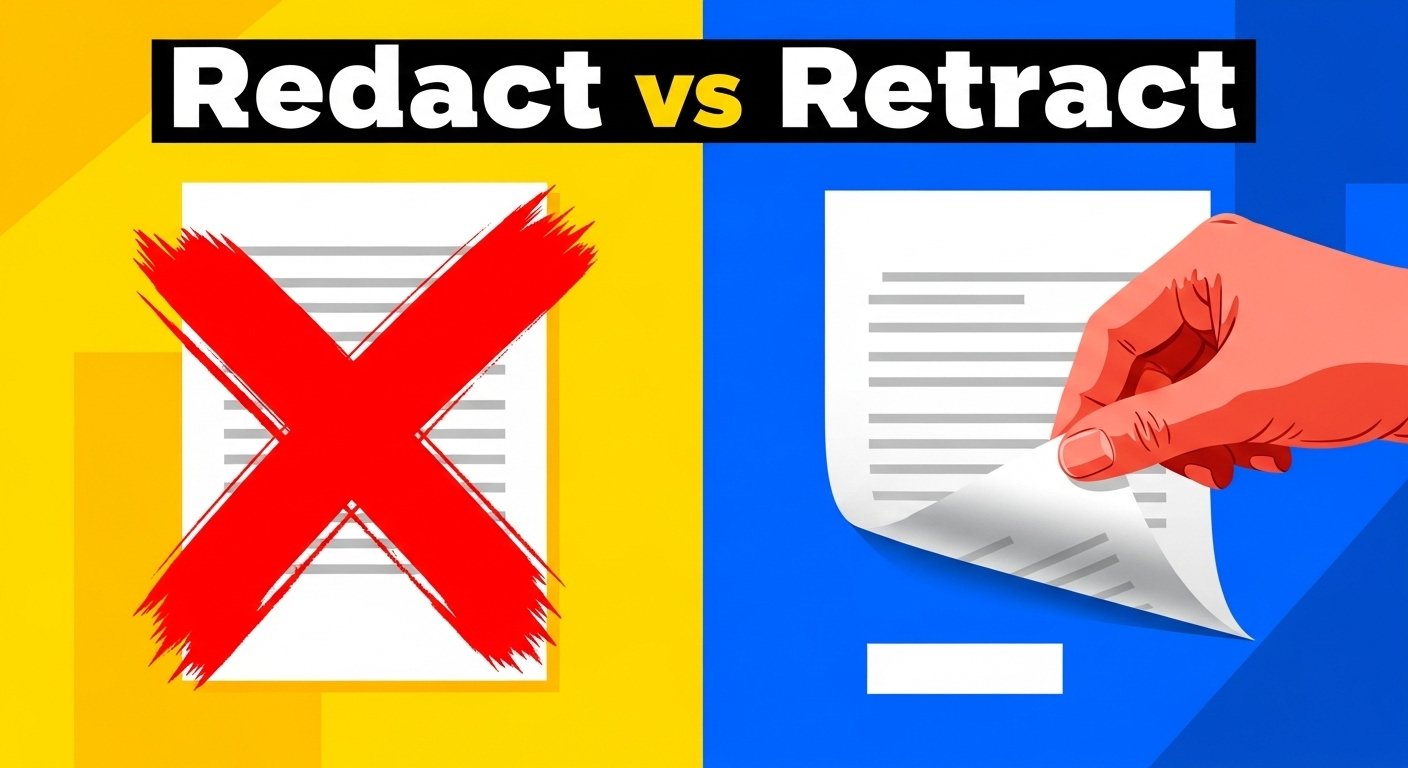
While redact and retract may look and sound similar, they have very different meanings:
- Redact: To edit or prepare a document for publication, often removing sensitive or confidential information.
- Retract: To withdraw, pull back, or take back a statement, action, or physical object.
Understanding the difference helps prevent confusion in legal, professional, and everyday communication.
The Origin of Redact and Retract
Origin of the Word “Redact”
The word redact comes from the Latin redactus, meaning “to reduce, to drive back, or to call in.” It evolved in English to refer specifically to editing documents, often to remove confidential or inappropriate content.
Origin of the Word “Retract”
Retract is derived from the Latin retractus, meaning “to draw back.” It is used both literally (physically drawing something back) and figuratively (withdrawing a statement or claim).
Why the Words Are Confused
The confusion arises because both words:
- Start with “re-”
- Are verbs
- Are used in formal contexts such as law, government, or publishing
However, their applications are quite distinct, which makes understanding their nuances important.
Redact: Meaning, Usage, and Examples
Definition: To edit a document for publication by removing or obscuring sensitive content.
Forms: redacts, redacted, redacting
Common Scenarios:
- Legal documents released to the public
- Government files with classified information
- Transcripts containing offensive language
Example Sentences:
- “On Monday, barrister for the coroner Ronan Daly told the court that following consideration of whether the files would need to be redacted due to containing sensitive information, both the Garda and the PSNI have agreed that they can be submitted largely intact.” (The Belfast Telegraph)
- “In a perfect world, if we had free cameras, free storage and someone to redact it, I’d be on top of it today,” Green Bay Police Chief Andrew Smith said. (The Green Bay Press Gazette)
Retract: Meaning, Usage, and Examples
Definition: To draw back, withdraw, or take back a statement, action, or object.
Forms: retracts, retracted, retracting
Common Scenarios:
- Public figures withdrawing statements after backlash
- Legal retractions in court proceedings
- Physical actions such as pulling back a hand or mechanical arm
Example Sentences:
- “After receiving the original letter from Wynne’s lawyer, Brown would not retract his comments or apologize for them and now after receiving the follow-up notice of libel, his position is unchanged.” (The National Post)
- “In recent weeks, Palestinian officials have stepped up calls for London to retract its support for a Jewish homeland in the area of the former British mandate, arguing that the land didn’t belong to Britain and that it therefore had no right to promise it to the Zionist movement.” (The Times of Israel)
Redact vs Retract: Key Differences
| Feature | Redact | Retract |
|---|---|---|
| Meaning | Edit or remove content from a document | Withdraw or pull back a statement/action |
| Origin | Latin redactus | Latin retractus |
| Verb Type | Transitive | Transitive or intransitive |
| Usage Context | Legal, government, publishing | Legal, public statements, physical actions |
| Example | Redacting confidential files | Retracting a false statement |
Common Mistakes
- Confusing the meaning: Using redact when you mean retract, e.g., “He redacted his statement” (incorrect).
- Mixing forms: Using redacted and retracted interchangeably.
- Overgeneralizing: Applying retract to document editing.
- Ignoring context: Not considering whether the action is physical, verbal, or textual.
Redact and Retract in Everyday Writing
- In Emails: Use redact for confidential content and retract for correcting statements.
- In News Writing: Journalists redact sensitive information and report when officials retract claims.
- On Social Media: Public figures may retract controversial posts.
- In Legal Writing: Redact court documents; retract admissions or claims as needed.
- In Publishing: Authors may redact manuscripts for sensitive material before release.
Which Word Should You Use?
- For Legal and Government Documents: Redact
- For Public Statements and Corrections: Retract
- For Academic or Professional Writing: Use the word that accurately conveys editing vs withdrawing
- For General Writing: Always check the context—textual vs verbal vs physical
Conclusion
Understanding the difference between redact and retract ensures precise communication. Redact is about editing documents; retract is about withdrawing statements or actions. Misusing these words can lead to misunderstandings, especially in legal, professional, and public contexts. Use this guide to confidently choose the correct term in writing and speech.