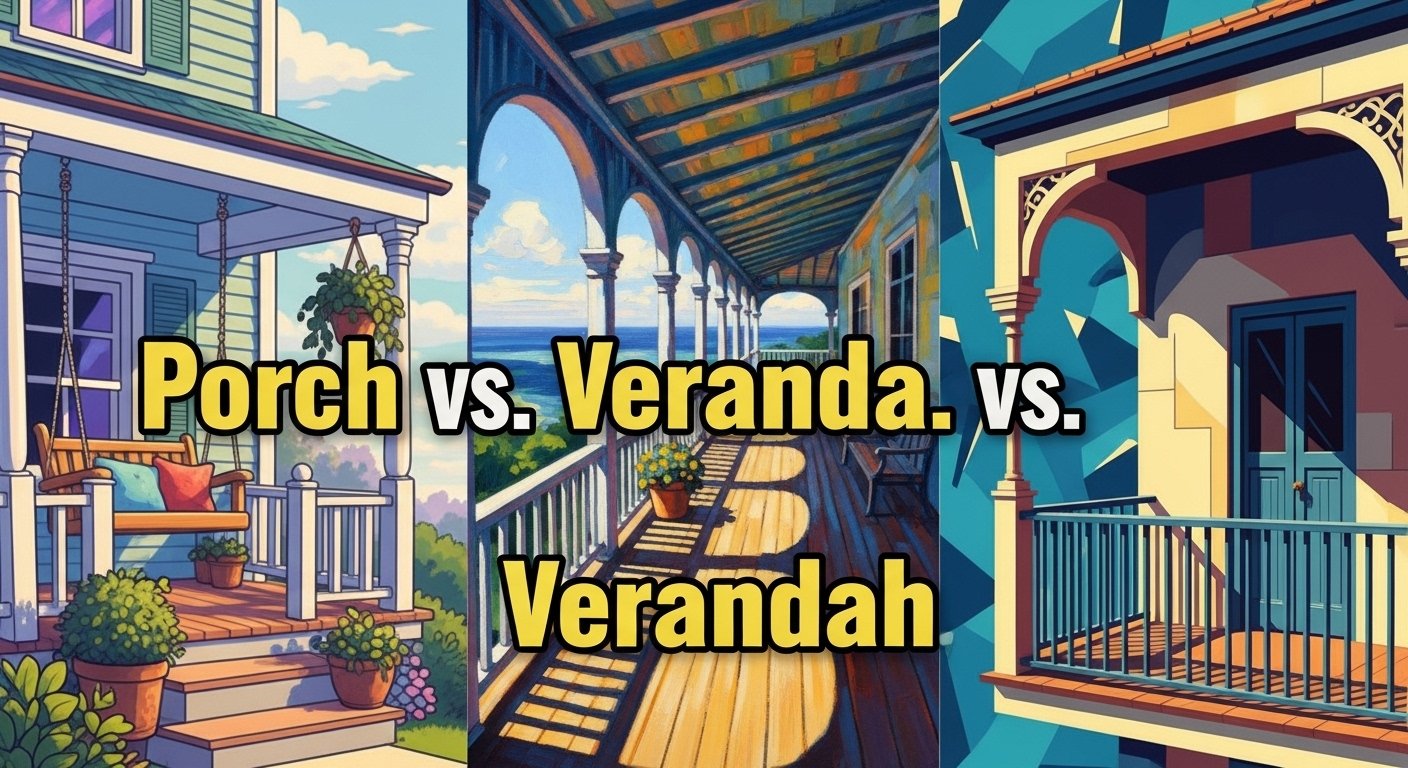
Porch vs. Veranda vs. Verandah: Definitions, Differences, and Usage
Understanding the terms porch, veranda, and verandah can be confusing, especially for writers, homeowners, and interior design enthusiasts. While these words are often used interchangeably, each has its own distinct meaning, structure, and cultural usage.
In this article, we’ll explore the differences, origins, and proper usage of these outdoor home spaces. By the end, you’ll know exactly when to use each term and how to incorporate them in writing and conversation.
Porch, Veranda, or Verandah: Quick Answer
A porch is a small, covered area attached to the front or back of a house, usually supported by beams or columns.
A veranda is larger, often wrapping around the house, with a platform and railings, providing an open outdoor space for relaxing or entertaining.
Verandah is simply an alternate spelling of veranda, historically more common in British English but largely interchangeable today.
The Origins of Porch, Veranda, and Verandah
Origin of the Word “Porch”
The word porch comes from the Latin porticus, meaning a covered entrance or colonnade. Porches became common in North America and Europe as functional entry spaces for homes, often for removing shoes or sheltering from weather.
Origin of the Word “Veranda”
Veranda originated in India during the colonial era, referring to long, open, covered balconies attached to houses. The British adopted the term in the 18th and 19th centuries, bringing it into common English usage.
Verandah: A British Variation
The verandah spelling was popular in British English literature, including the works of Jane Austen. Over time, the simpler veranda spelling has become more universal, especially in modern writing and design texts.
Porch vs. Veranda: Key Differences
| Feature | Porch | Veranda / Verandah |
|---|---|---|
| Size | Usually small | Larger, can wrap around house |
| Location | Front or back door | Along sides of house, sometimes surrounding it |
| Structure | Supported by beams/columns | Platform-based with railings |
| Use | Shelter, casual sitting | Relaxing, entertaining, scenic view |
| Cultural Usage | North America, Newfoundland | India, UK, Australia, colonial architecture |
Porch vs. Veranda Around the World
In the United States
Porch is the dominant term in the US. Most Americans are familiar with porches as entry spaces, while veranda is less commonly used and can seem formal or old-fashioned.
In Australia
Both porch and veranda are used, but veranda tends to be more common. It refers to larger, often wraparound outdoor spaces, regardless of the house’s architectural style.
In the UK and Canada
Verandah may appear in historical contexts or literature. Modern usage often favors veranda, though both are technically correct.
Sentence Examples Using “Porch”
- My husband and I sat on the porch and watched the sunset together.
- She swept the leaves off the porch before watering the garden.
- The kids played on the porch while I cooked dinner.
- The porch light flickered in the wind, casting shadows on the wall.
Sentence Examples Using “Veranda / Verandah”
- Our grandparents relaxed on the veranda of their hotel and enjoyed the ocean view.
- The hotel had a beautiful veranda where we could read and unwind.
- Guests eventually moved out onto the veranda to chat and laugh.
- The old colonial house featured a veranda wrapping around the entire building.
When to Use Porch vs. Veranda vs. Verandah
- Use porch when describing a small, covered entry space.
- Use veranda for larger, open spaces attached to the side or front of a house.
- Use verandah in formal, historical, or British contexts to add authenticity.
Porch is simpler, widely understood, and fits most casual descriptions. Veranda is slightly more formal and evokes a larger, relaxing outdoor space.
Common Mistakes
- Using Porch and Veranda Interchangeably – While related, they differ in size and structure.
- Mixing Spelling of Veranda and Verandah – Stick to one spelling per text or article.
- Assuming Cultural Usage is Universal – Porch is more common in North America, veranda/verandah elsewhere.
- Overcomplicating Simple Descriptions – Porch is usually enough unless emphasizing size or style.
Porch vs. Veranda in Writing and Design
- Emails & Blogs: Use porch for casual home-related writing; veranda for architectural or travel descriptions.
- Interior Design & Home Listings: Veranda suggests luxury, openness, or colonial-style homes.
- Social Media & Lifestyle Posts: Porch works for everyday family or seasonal content.
Popularity & Trends
- Google Trends shows “porch” is searched more in the US.
- Veranda / Verandah sees higher usage in Australia, India, and the UK.
- Context-Based Usage: Porch for entryways, veranda for leisure spaces and scenic views.
Conclusion
Choosing between porch, veranda, and verandah depends on size, structure, cultural context, and writing style.
- Porch: Small, functional, North American favorite.
- Veranda: Larger, scenic, often wraps around a house.
- Verandah: British spelling, slightly historical or formal.
For most writing and interior design contexts, knowing these subtle differences helps your description feel accurate and polished.