Diametrically Opposed: Meaning, Origin, Usage, and Real Examples
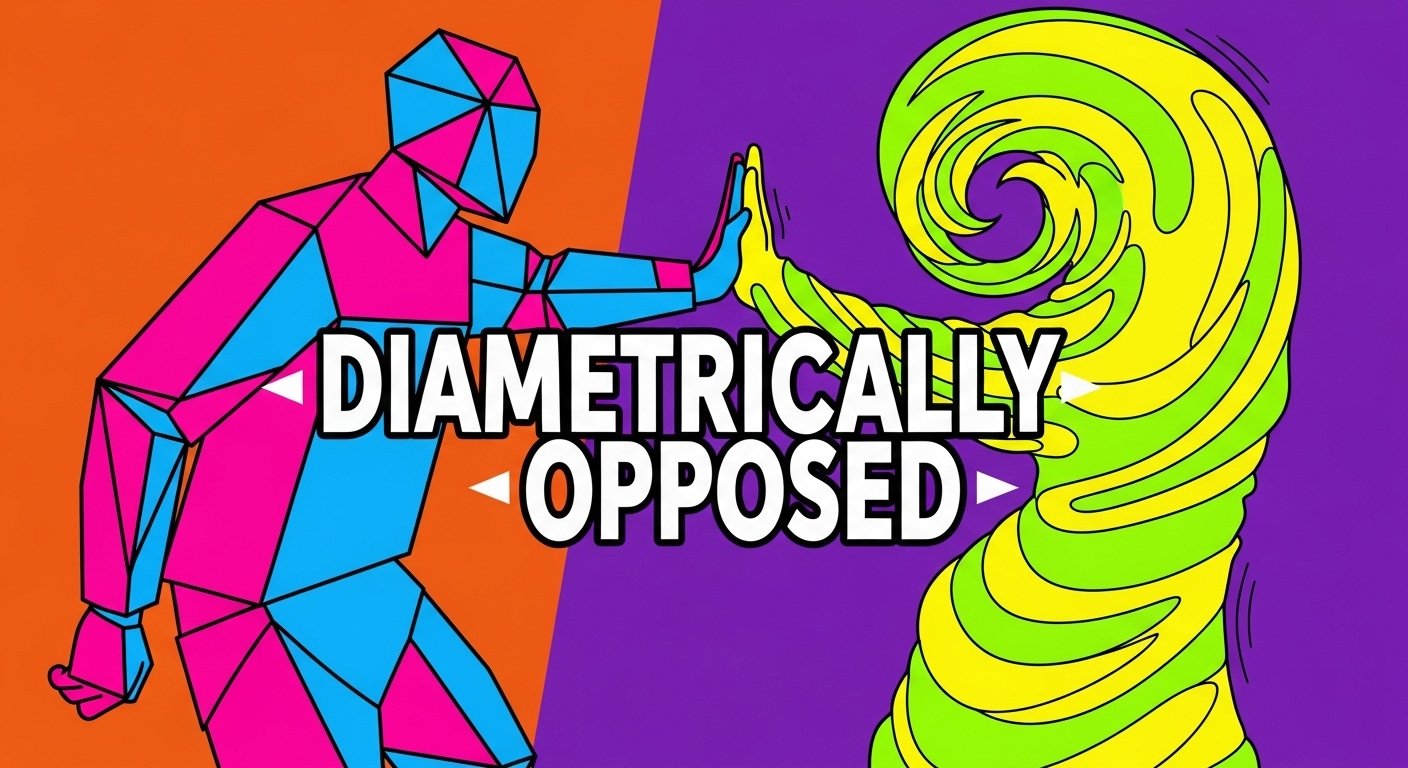
The phrase diametrically opposed means completely and directly opposite in position, opinion, or nature. It describes two ideas, beliefs, arguments, or positions that are in total opposition to each other.
The expression comes from geometry. Imagine a circle. Draw a straight line from one side of the circle to the other, passing through the center. The two points at the ends of that line are directly opposite each other — separated by the full diameter. That visual image explains why the phrase is used to describe complete opposition.
In modern English, the term is most commonly used in discussions about politics, religion, law, philosophy, and personal opinions.
The Origin of Diametrically Opposed
Origin of the Word “Diameter”
The word diameter comes from the Greek word diametros, which means “measuring across.” It refers to a straight line passing from one side of a circle to the other through its center.
Over time, the word moved into Latin and then into English. By the 14th century, diameter was already used in mathematical contexts.
The Development of “Diametrical” and “Diametrically”
From diameter, English formed the adjective diametrical, meaning “relating to a diameter” or “directly opposite.”
Later, the adverb diametrically developed, meaning “in a way that is directly opposite.” When combined with opposed, the phrase became a powerful metaphor for complete contrast.
The expression diametrically opposed has been in use since at least the mid-1600s and remains common in contemporary writing.
Why the Phrase Became Figurative
Although diametrically can describe physical positions, it is now used mostly in figurative contexts. Instead of describing points in a circle, it describes:
- Opposing political views
- Conflicting legal interpretations
- Religious disagreements
- Opposite personality traits
The metaphor works because geometric opposition is absolute — there is no middle ground between two diametrically opposite points.
Literal vs Figurative Meaning
Literal Meaning
In geometry, two points are diametrically opposite if they lie on opposite ends of a diameter line in a circle.
Example (literal):
- The two entrances are diametrically opposite each other in the stadium.
Figurative Meaning
In modern usage, the phrase is usually metaphorical. It suggests that two ideas or positions are entirely contradictory.
Example (figurative):
- Their views on taxation are diametrically opposed.
The figurative meaning is now far more common than the literal one.
Diametrically Opposed vs Similar Expressions
English has many phrases that indicate opposition, but diametrically opposed implies the strongest possible contrast.
Here is how it compares:
| Phrase | Strength of Opposition | Meaning Nuance |
|---|---|---|
| Opposed | Moderate | Disagreement exists |
| Strongly opposed | Strong | Clear disagreement |
| Completely opposed | Very strong | Total rejection |
| Diametrically opposed | Absolute | Direct and total opposition |
Unlike “different” or “contrary,” this phrase suggests no overlap whatsoever.
Diametrical Opposition: Noun Form
While diametrically opposed is the most common form, the noun phrase diametrical opposition is also correct.
Example:
- The two theories exist in diametrical opposition to each other.
Both forms are grammatically sound, but the adjectival phrase is used more frequently in journalism and academic writing.
Common Contexts Where Diametrically Opposed Is Used
In Politics
Political debates often involve parties or individuals holding diametrically opposed viewpoints.
Example:
- The candidates hold diametrically opposed positions on climate policy.
Journalistic writing frequently uses this phrase to highlight stark contrasts.
In Religion
Religious interpretations can sometimes lead to diametrically opposed conclusions.
Example:
- Two scholars read the same scripture but reached diametrically opposed interpretations.
This usage emphasizes how identical sources can produce opposite results.
In Law
Courts may analyze whether regulations are compatible or in conflict.
Example:
- The judge ruled that the local law was not diametrically opposed to state regulations.
Legal writing uses the phrase to signal total contradiction rather than minor differences.
In International Relations
Diplomatic disagreements are often described using this phrase.
Example:
- The countries maintain diametrically opposed positions on territorial claims.
The phrase conveys seriousness and depth of disagreement.
Real-World Usage Examples
The expression frequently appears in reputable newspapers and global publications.
For instance:
- A journalist from The Lexington Herald-Leader questioned how people could worship the same Lord yet arrive at diametrically opposed positions.
- The Manila Times described a situation that was diametrically opposed to a different national position.
- The Milwaukee Journal Sentinel used the term in a legal ruling context.
- The Belfast Telegraph discussed political figures coming from diametrically opposed standpoints.
These examples show how widely accepted and established the phrase is in formal writing.
Grammar and Structure
Standard Construction
The most common grammatical pattern is:
Subject + be + diametrically opposed + to + object
Example:
- Their philosophies are diametrically opposed to each other.
Notice that the preposition to is required.
Incorrect:
- Their views are diametrically opposed with each other.
Correct:
- Their views are diametrically opposed to each other.
Placement in a Sentence
The phrase can appear:
- After linking verbs (are, were, seem)
- In relative clauses
- In complex compound sentences
Example:
- Although they studied together, their conclusions were diametrically opposed.
Common Mistakes with Diametrically Opposed
Mistake 1: Using It for Minor Differences
The phrase should only be used for total opposition. Using it for small disagreements weakens clarity.
Incorrect:
- We are diametrically opposed about which restaurant to choose.
Unless the disagreement reflects deep principles, this may be exaggerated.
Mistake 2: Omitting “To”
Some writers forget the necessary preposition.
Incorrect:
- Their ideas are diametrically opposed each other.
Correct:
- Their ideas are diametrically opposed to each other.
Mistake 3: Confusing It with “Contradictory”
While similar, “contradictory” refers to statements that cannot both be true. “Diametrically opposed” emphasizes opposite positions rather than logical incompatibility.
Mistake 4: Overuse in Informal Writing
In casual conversation, the phrase can sound overly formal.
Instead of:
- We’re diametrically opposed on pizza toppings.
You might simply say:
- We completely disagree.
Synonyms and Alternatives
If you want stylistic variety, consider these alternatives:
- Completely opposite
- Totally opposed
- In direct opposition
- Polar opposites
- In total conflict
- Fundamentally opposed
However, none carry the same geometric precision as diametrically opposed.
When Should You Use Diametrically Opposed?
In Academic Writing
The phrase works well in essays, research papers, and analysis because it clearly communicates strong contrast.
Example:
- The two economic models are diametrically opposed in their assumptions.
In Journalism
Writers use it to emphasize conflict between political parties, ideologies, or institutions.
In Professional Communication
It can be used in business contexts to describe strategic differences:
- Our company’s mission is diametrically opposed to short-term profit thinking.
In Everyday Conversation
Although formal, it is still understandable and acceptable in educated speech.
Tone and Formality
The phrase is considered formal or semi-formal. It is common in:
- Academic discourse
- Legal writing
- Editorial journalism
- Political commentary
It is less common in casual text messages or informal social media posts.
Why the Phrase Remains Popular
Several reasons explain its continued usage since the 1600s:
- It provides vivid imagery.
- It conveys absolute contrast.
- It sounds authoritative.
- It works across disciplines (math, politics, religion, law).
Because it is rooted in geometry, it offers a universally understood metaphor.
Frequently Asked Questions
Is diametrically opposed a real phrase?
Yes. It has been used in English since the mid-17th century and appears frequently in reputable publications.
Does it always mean completely opposite?
Yes. The phrase implies total and direct opposition, not partial disagreement.
Can it describe physical positions?
Yes, but that usage is less common today. It originally referred to opposite points on a circle.
What is the noun form?
The noun form is diametrical opposition.
Is it formal English?
Yes. It is generally considered formal or semi-formal and is often used in academic and journalistic writing.
Can I use it in exams?
Yes. It is grammatically correct and appropriate for academic contexts.
Conclusion
The phrase diametrically opposed has a long history dating back to the 1600s. Rooted in the geometric concept of a diameter, it evolved into a powerful metaphor for complete and direct opposition.
Derived from the Greek diametros, meaning “measuring across,” the term moved from mathematics into everyday language. Today, it is widely used in politics, religion, law, and academic writing to describe positions that stand in absolute contrast.
When used correctly — with the preposition “to” and reserved for true opposites — the phrase adds clarity and authority to your writing. Its endurance over centuries proves its effectiveness as a precise and vivid expression of total opposition.