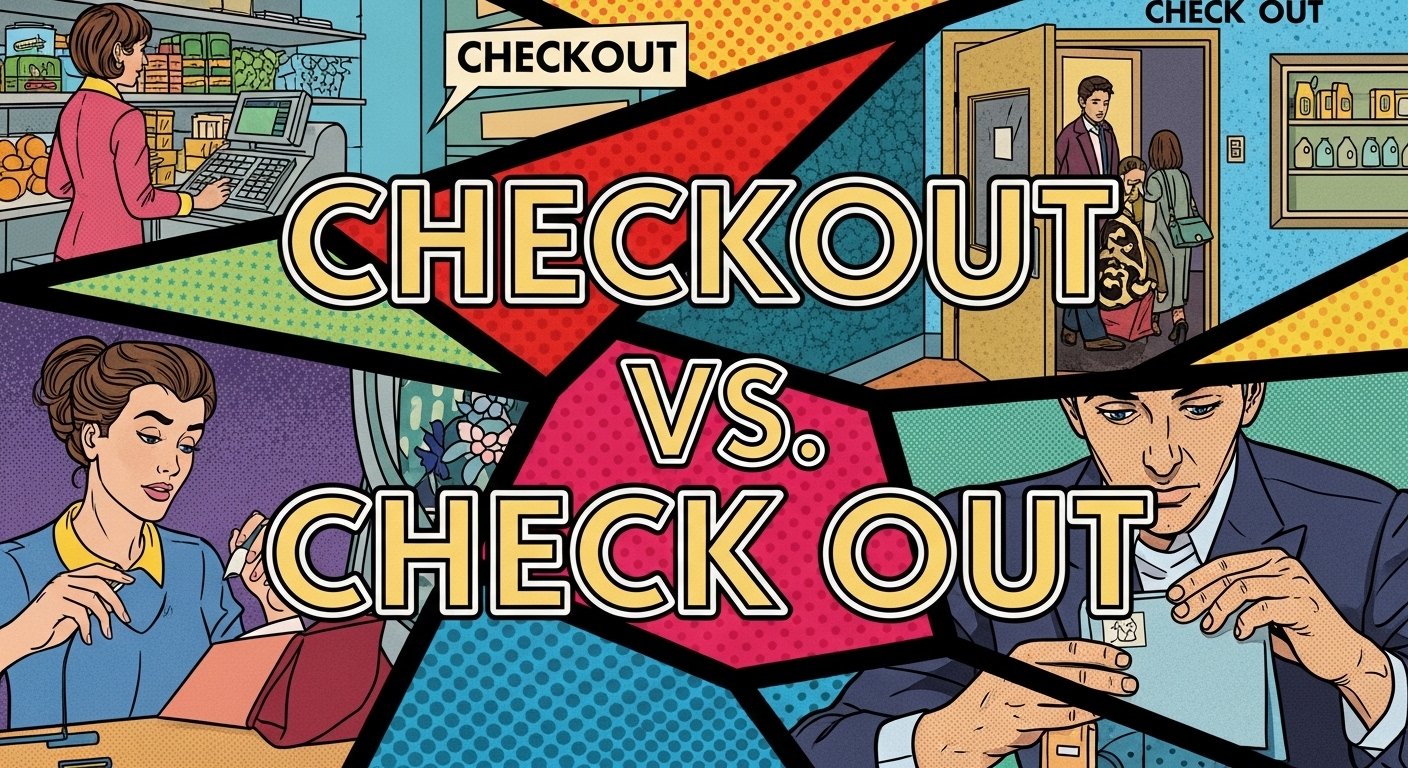
Checkout vs. Check Out: Grammar, Usage, and Real-Life Examples
The difference between checkout and check out lies in their grammatical roles:
- Checkout (one word) is a noun or adjective. Example: “I went to the supermarket checkout.”
- Check out (two words) is a verb. Example: “I need to check out of the hotel by noon.”
Occasionally, the noun form is hyphenated as check-out, but the unhyphenated version is more widely accepted in modern English.
The Origin of Checkout and Check Out
Origin of the Word “Check”
The word check comes from the Old French eschequier, meaning a chessboard or a mark of inspection. Over centuries, it evolved in English to mean verification, control, or examination.
Formation of Checkout
By combining check with out, the verb phrase check out was formed. Over time, the noun form describing the location or process of paying (like a supermarket or hotel) became checkout.
Why One Word vs. Two Words Exists
English often transforms verb phrases into nouns over time. Similar to setup (noun) vs set up (verb), checkout follows this pattern. The two-word form remains the verb, while the single word describes the location or concept.
British English vs. American English Usage
British English Usage
- In the UK, checkout is standard for stores or online purchases.
- The verb remains check out, as in: “Please check out of your room before 11 am.”
American English Usage
- Americans also use checkout for the noun and check out for the verb.
- Hyphenation (check-out) is rare but acceptable in some formal writing.
Comparison Table
| Form | Part of Speech | Example (UK) | Example (US) |
|---|---|---|---|
| Checkout | Noun/Adj | I went to the checkout. | Pay at the checkout counter. |
| Check out | Verb | Check out of the hotel by 10 am. | Make sure to check out online. |
Which Form Should You Use?
For US Audiences
Use checkout for the noun and check out for the verb. Example: “I lined up at the checkout and then checked out of my hotel.”
For UK and Commonwealth Audiences
Follow the same rules. Example: “The supermarket checkout was busy, so we had to check out quickly.”
For Global Audiences
To avoid confusion, stick to checkout (noun) and check out (verb) universally.
For Exams and Academic Writing
Always separate the verb: check out. The noun checkout can be used when describing locations, processes, or concepts.
Common Mistakes with Checkout and Check Out
Mistake 1: Using Checkout as a Verb
Incorrect: “I checkout of the hotel at noon.”
Correct: “I check out of the hotel at noon.”
Mistake 2: Mixing Forms in a Sentence
Incorrect: “Please check out the checkout.”
Better: “Please check out at the checkout counter.”
Mistake 3: Confusing Hyphenation
Check-out is unnecessary in most modern texts. Stick with checkout.
Mistake 4: Overgeneralizing
Using checkout for all scenarios can sound awkward. Remember, the verb check out describes the action.
Checkout and Check Out in Everyday Examples
In Emails
- Verb: “Don’t forget to check out the new report.”
- Noun: “The checkout process was quick and smooth.”
In News Writing
- Verb: “Readers can check out the full article online.”
- Noun: “Staff at the checkout handled the rush efficiently.”
On Social Media
- Verb: “Check out this amazing video!”
- Noun: “The app simplifies your checkout experience.”
In Formal Writing
- Verb: “Participants should check out the survey before submission.”
- Noun: “The hotel’s checkout time is strictly enforced.”
In Retail and Hospitality
- Verb: “Guests must check out by 11 am.”
- Noun: “The supermarket checkout was crowded on Saturday.”
Google Trends & Usage Data
Search Popularity
Check out (verb) is searched more frequently than checkout (noun), especially in online shopping and hotel-related queries.
Country-Based Usage
- US and UK audiences largely follow the same rules.
- Commonwealth countries prefer checkout for shopping, check out for actions.
Context-Based Usage
- Online stores: checkout
- Hotel stays: both noun and verb relevant
- Informal phrases: check out (as in “look at this”)
Comparison Table: Checkout vs Check Out
| Feature | Checkout | Check Out |
|---|---|---|
| Part of Speech | Noun / Adjective | Verb |
| Example 1 | The checkout line was long. | Please check out before noon. |
| Example 2 | Online checkout is simple. | Check out the latest episode. |
| Hyphenation | Optional: check-out | Not used |
Frequently Asked Questions
Is checkout a real word?
Yes, checkout is a valid noun and adjective in all English varieties.
Is check out a real word?
Check out is a verb phrase, and it is correct when describing actions.
Do they mean different things?
Yes. Checkout = location or process (noun). Check out = action (verb).
Which form is more common?
Check out (verb) appears more often in everyday conversation and online content.
Can I use both in one article?
Yes, but make sure the usage matches the part of speech. Verb = two words; noun = one word.
Which form should students use?
Follow standard grammar: checkout for nouns, check out for verbs.
Which form is better for content writing?
Use both correctly according to context; search engines recognize proper noun-verb distinctions.
Conclusion
Understanding the difference between checkout and check out is simple once you remember:
- Checkout = noun/adjective (place, process, concept)
- Check out = verb (action, instruction)
Correct usage avoids confusion in writing, improves clarity, and ensures your content is professional and reader-friendly.