Annex vs Annexe: Spelling Rules, Usage, and Real Examples
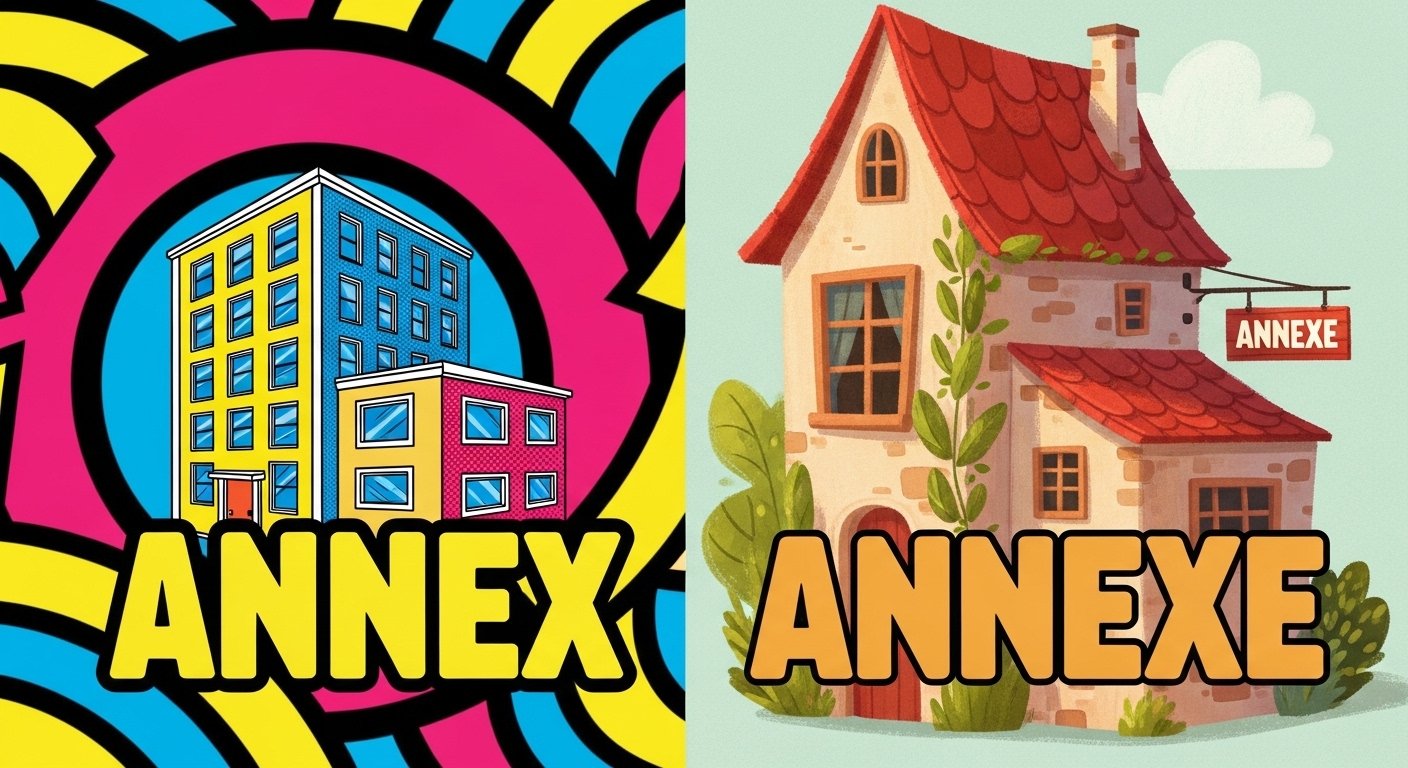
The difference between annex and annexe comes down to regional spelling conventions.
- In American and Canadian English, annex is used as both a noun and a verb.
- In British English, annex is the standard verb form, while the noun is sometimes spelled annexe.
In short:
- US & Canada → annex (noun and verb)
- UK → annex (verb), annexe (sometimes used as noun)
Both spellings are correct — but only within the right regional context.
The Origin of Annex or Annexe
Origin of the Word “Annex”
The word annex comes from the Latin annexus, meaning “to bind to” or “to tie together.” It entered English through Old French and Middle English, carrying the core meaning of attaching or adding something.
Historically, the word has always functioned as a verb first, meaning:
- To attach
- To append
- To incorporate territory or property
Over time, it also developed a noun meaning, referring to something added or attached.
How “Annex” Became a Noun
English commonly turns verbs into nouns without changing the spelling. This is exactly what happened with annex.
As a noun, it means:
- An extension to a main building
- Something added or appended
For example:
- A school annex
- A legal annex to a treaty
In North American English, the spelling stayed consistent: annex for both forms.
Why Spelling Differences Exist
The difference between annex and annexe reflects a broader pattern between British and American spelling systems.
British English often preserves French-influenced endings such as:
- centre
- theatre
- defence
Similarly, the noun annexe reflects a French-style ending.
American English simplified many spellings in the 19th century, particularly under the influence of lexicographer Noah Webster, who favored streamlined forms. As a result, American English standardized annex for both noun and verb.
British English vs American English Spelling
British English Usage
In British publications:
- Annex is typically used as a verb.
- Annexe is sometimes used as a noun.
Examples from British media:
- The Telegraph: “On her first evening, Ellis was offered the annexe room off Lord Bath’s bedroom.”
- The Guardian: “The detail referring to the possible military dimensions is contained in the annexe.”
- BBC News: “Only an annex built in recent years would qualify.”
- The Economist: “The evidence gathered in a 12-page annex is hard to interpret.”
Notice that even within UK publications, both spellings appear for the noun. However, annexe is distinctly British and rarely appears in North American sources.
American English Usage
In the United States and Canada, annex is used universally.
Examples from North American publications:
- Los Angeles Times: “This time of year, the Columbia University Faculty Club becomes something of a Wall Street annex.”
- Arizona Republic: “The law allowed Glendale to annex the land.”
- Winnipeg Free Press: “They vacated the second floor theatre and book annex.”
In North America:
- Annex (noun) → building extension
- Annex (verb) → to attach or incorporate
The spelling annexe is virtually nonexistent in American or Canadian publications.
Comparison Table
| Region | Verb Form | Noun Form | Common Practice |
|---|---|---|---|
| United States | annex | annex | Standard form |
| Canada | annex | annex | Standard form |
| United Kingdom | annex | annex / annexe | Both appear |
| Australia | annex | usually annexe | British influence |
Which Spelling Should You Use?
For US Audiences
Use annex for both noun and verb.
Example:
- The city plans to annex neighboring land.
- The hospital built a new annex.
Using annexe in American writing may appear incorrect or overly British.
For UK and Commonwealth Audiences
You may use:
- Annex as a verb
- Annexe as a noun
However, even in the UK, many publications now use annex for both forms. Check your publication’s style guide.
For Global Writing
If you are writing for an international audience, annex is the safest and most widely understood form.
It avoids regional confusion and is globally recognized.
For Exams and Academic Writing
Follow your institution’s required variety of English:
- IELTS (British orientation) → annexe (noun) may be preferred
- TOEFL (American orientation) → annex
Consistency matters more than the specific choice.
Common Mistakes with Annex or Annexe
Mistake 1: Thinking One Form Is Wrong
Neither spelling is incorrect. The issue is regional consistency, not correctness.
Mistake 2: Mixing Spellings in One Text
Avoid writing:
- The city will annex the land and build a new annexe.
Unless you are deliberately using British conventions, mixing forms can look careless.
Mistake 3: Confusing Meaning
Both words mean the same thing when used as nouns. The difference is spelling only.
However, remember:
- Annex (verb) = to attach, especially territory
- Annex (noun) = extension of a building
Mistake 4: Overcorrecting
Some writers assume British English always requires annexe. In reality, many British publications still use annex.
Overcorrecting can introduce inconsistency.
Annex or Annexe in Everyday Examples
In Emails
- Please see the annex for additional details. (US)
- Please see the annexe for additional details. (UK possible)
In News Writing
Political usage often appears in international reporting:
- The country attempted to annex disputed territory.
- The school opened a science annex to handle enrollment growth.
On Social Media
In informal writing, regional spelling rules still apply, but many users default to the American spelling annex because of its global dominance online.
In Formal Writing
Legal documents often use “annex” to refer to supplementary sections:
- Annex A: Financial Statements
- Annex B: Supporting Evidence
Even in British legal contexts, annex frequently appears.
In Law and International Relations
The verb form is common in geopolitical contexts:
- A country may annex land following a conflict.
This usage appears consistently as annex, regardless of region.
Annex or Annexe: Google Trends and Usage Data
Search Popularity
Search engine data consistently shows:
- Annex dominates globally.
- Annexe has strong concentration in the UK.
The American spelling generates significantly more search volume worldwide.
Country-Based Usage
- United States → almost exclusively “annex”
- Canada → overwhelmingly “annex”
- United Kingdom → mixed usage
- Australia and New Zealand → “annexe” more common in noun form
Context-Based Usage
The spelling variation mainly appears when referring to buildings.
In political contexts (e.g., territorial expansion), annex is universally used as a verb.
Comparison Table: Annex vs Annexe
| Feature | Annex | Annexe |
|---|---|---|
| Used as verb | Yes | No |
| Used as noun | Yes | Yes (UK mainly) |
| Common in US | Yes | Rare |
| Common in UK | Yes | Yes |
| Academic acceptability | Yes | Yes (UK) |
| Globally dominant | Yes | No |
Frequently Asked Questions
Is annex a real word?
Yes. It functions as both a noun and a verb in English.
Is annexe a real word?
Yes. It is a British spelling of the noun form of annex.
Do they mean different things?
No. The meaning is identical. The difference is regional spelling.
Which spelling is more common?
Globally, annex is far more common, especially online and in North America.
Can I use both in one article?
You should avoid mixing spellings unless you are discussing the difference itself.
Choose one style and remain consistent.
Which spelling should students use?
Students should follow their country’s standard or their exam board’s guidelines.
When unsure, annex is the safer global choice.
Which spelling is better for content writing?
For SEO and international audiences, annex is generally better due to higher search volume and broader recognition.
However, UK-based publications may prefer annexe for local credibility.
Conclusion
The difference between annex and annexe is not about meaning — it is about regional spelling preference.
- North America uses annex for both noun and verb.
- British English sometimes uses annexe for the noun.
- The verb form is always annex.
If you are writing for a global audience, choose annex for clarity and consistency. If you are writing specifically for a UK publication, check the style guide — but remember that even British outlets frequently use “annex.”