Role vs. Roll: Grammar Rules, Meaning, and Proper Usage
Many English words sound identical but carry different meanings. Role and roll are prime examples of such homophones. This similarity in pronunciation often confuses both learners and native speakers alike. Understanding the difference is essential for clear writing and accurate communication.
Role vs. Roll: Quick Overview
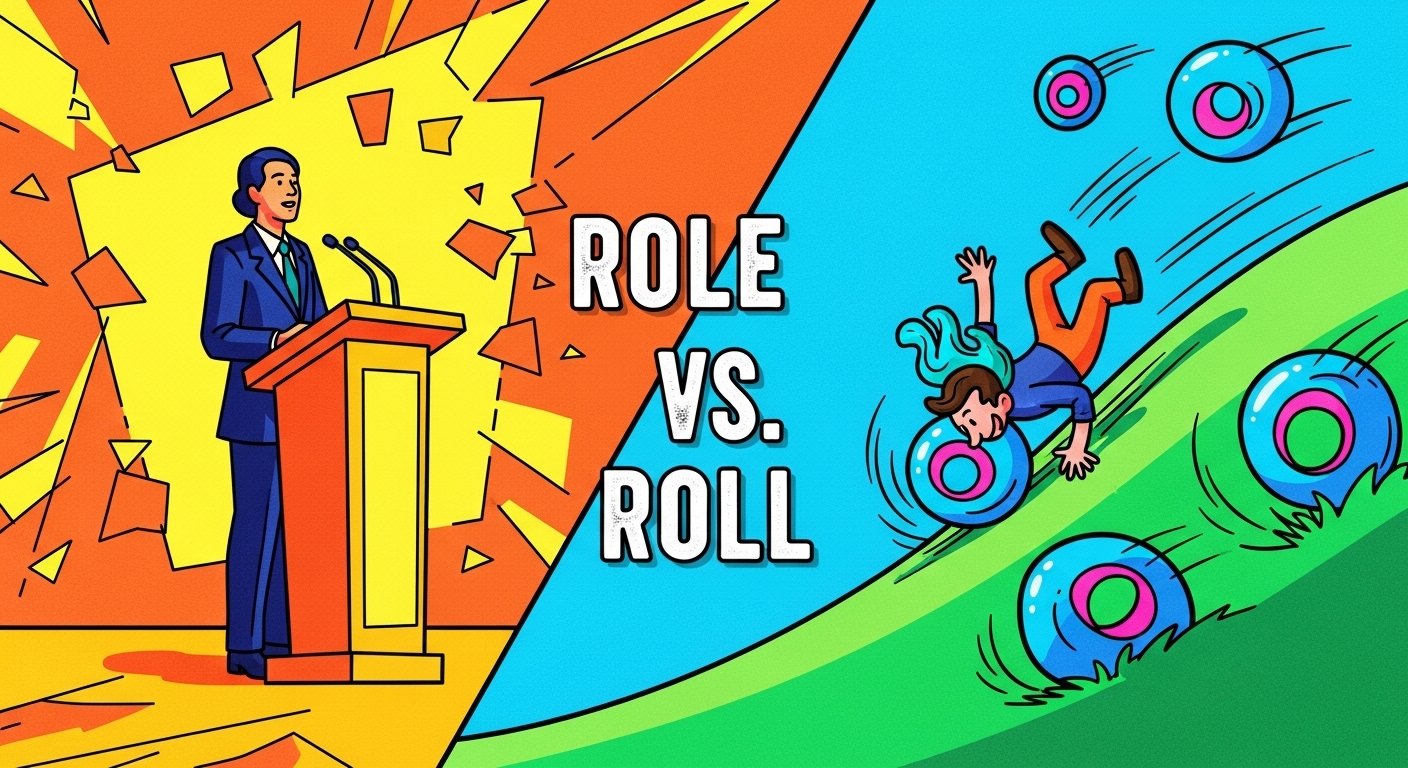
- Role – Refers to a person’s function, position, or part in a scenario.
- Roll – Can be a noun or verb with multiple meanings, including movement, lists, sound, or a small item.
In short, the key difference lies in meaning: role is singular in definition, while roll has broad and versatile uses.
The Origins of Role and Roll
The Latin Roots
Both words trace back to the Latin word rotula, meaning “small wheel.” Over centuries, they diverged into distinct meanings and spellings in English.
Roll: From Scrolls to Movement
- 1200s: Old French rolle meant a rolled-up scroll of parchment.
- 1300s: Rollen referred to turning or spinning repeatedly.
- 1600s: Roll evolved to describe both rapid movement and rhythmic sounds.
Role: From Performance to Responsibility
- 1600s: French rôle referred to a part played by a person in a play or performance.
- Over time, role expanded to describe duties, functions, and responsibilities in everyday life.
British vs. American Usage
While role and roll maintain the same meanings in both English variants, subtle differences exist in idiomatic expressions and frequency of use.
British English Usage
- “Roll call” is widely used in schools and military contexts.
- Phrases like “on a roll” are equally understood.
American English Usage
- Commonly used in professional and informal contexts.
- Lists, pastries, and idioms (“on a roll”) appear more frequently in everyday writing.
Comparison Table
| Word | Meaning | Common Usage |
|---|---|---|
| Role | Function, part, responsibility | Job duties, theater, life positions |
| Roll | Move, list, sound, item | Names, bread, thunder, parchment |
Choosing Between Role and Roll
For US Audiences
- Use roll for lists, actions, and idioms.
- Use role for positions, responsibilities, or theater parts.
For UK and Commonwealth Audiences
- Both words are used similarly, with idioms like “on a roll” being common.
For Academic Writing
- Stick to role when describing duties or positions.
- Avoid mixing with roll to prevent confusion.
Common Mistakes
Mistake 1: Confusing One for the Other
People often use role when they mean roll in idiomatic expressions, e.g., “on a role” (incorrect).
Mistake 2: Mixing Words in One Text
Switching between role and roll in the same paragraph can confuse readers.
Mistake 3: Misunderstanding Meaning
- Role = position or part.
- Roll = movement, list, or physical object.
Mistake 4: Overcorrecting
Avoid using roll in place of role in professional or academic contexts.
Role vs. Roll in Everyday Writing
In Emails
- “Please confirm your role in the project.” ✅
- “Please roll the attendance list.” ✅
In News and Reports
- “The mayor’s role is to oversee city planning.”
- “The honor roll recognizes student achievements.”
On Social Media
- “She’s on a roll this week!”
- “Casting calls for the lead role now open.”
In Formal Documents
- Role descriptions in job contracts.
- Rolls of participants or inventory lists.
Commonly Confused Phrases
Class Role vs Class Roll
- Class roll = list of students.
- Class role = student’s function in the class (rarely used).
On a Role vs On a Roll
- On a roll = performing well or being successful.
- On a role = incorrect usage.
Roll Call vs Role Call
- Roll call = taking attendance.
- Role call = incorrect, though occasionally seen in informal writing.
Review: Key Takeaways
- Roll is versatile: can describe movement, sound, lists, or physical items.
- Role is singular in meaning: it describes duties, functions, or parts in life or performance.
- Despite identical pronunciation, correct spelling is crucial for clarity.
Frequently Asked Questions
Is role a real word?
Yes, it is a noun describing a person’s function or part.
Is roll a real word?
Yes, it is a noun and verb with multiple definitions.
Do they mean the same thing?
No, role and roll are different in meaning.
Which is more common?
Both are common, but usage depends on context.
Can I use both in one article?
Yes, but only when each word fits its specific meaning.
Which should students use?
- Use role when describing duties or parts.
- Use roll for movement, lists, or idiomatic phrases.
Which is better for writing content?
Context matters: role for clarity in responsibilities, roll for action or lists.
Conclusion
While role and roll sound the same, their meanings differ significantly. Proper usage ensures your writing is professional, clear, and precise. Always remember: role = position or duty, roll = action, list, or item.